MOTS-C
Mitochondrial-Derived Metabolic
This lyophilized peptide must be reconstituted with RECON-S before use in research. Most customers forget to add it — don't get stuck waiting for a second order.
Add Reconstitution SolutionMOTS-c
MOTS-c is a mitochondrial-derived peptide (MDP) — a class of bioactive peptides encoded not by nuclear DNA but by the mitochondrial genome itself. Discovered in 2015 by researcher Changhan David Lee at the University of Southern California, MOTS-c represented a paradigm shift in mitochondrial biology research, establishing for the first time that mitochondria produce their own signaling peptides capable of traveling outside the mitochondria to regulate cellular metabolism at a systemic level. Encoded by the 12S rRNA gene of mitochondrial DNA, MOTS-c is a 16 amino acid peptide that has since become one of the most actively researched mitochondrial peptides in modern metabolic and longevity science, with published research examining its role in insulin sensitivity, glucose metabolism, skeletal muscle function, exercise adaptation, and cellular stress response across both animal and human research models.
Molecular Formula: C₁₀₁H₁₈₀N₃₆O₂₉S | Molecular Weight: ≈2,174 Da | Purity: ≥99% HPLC Verified
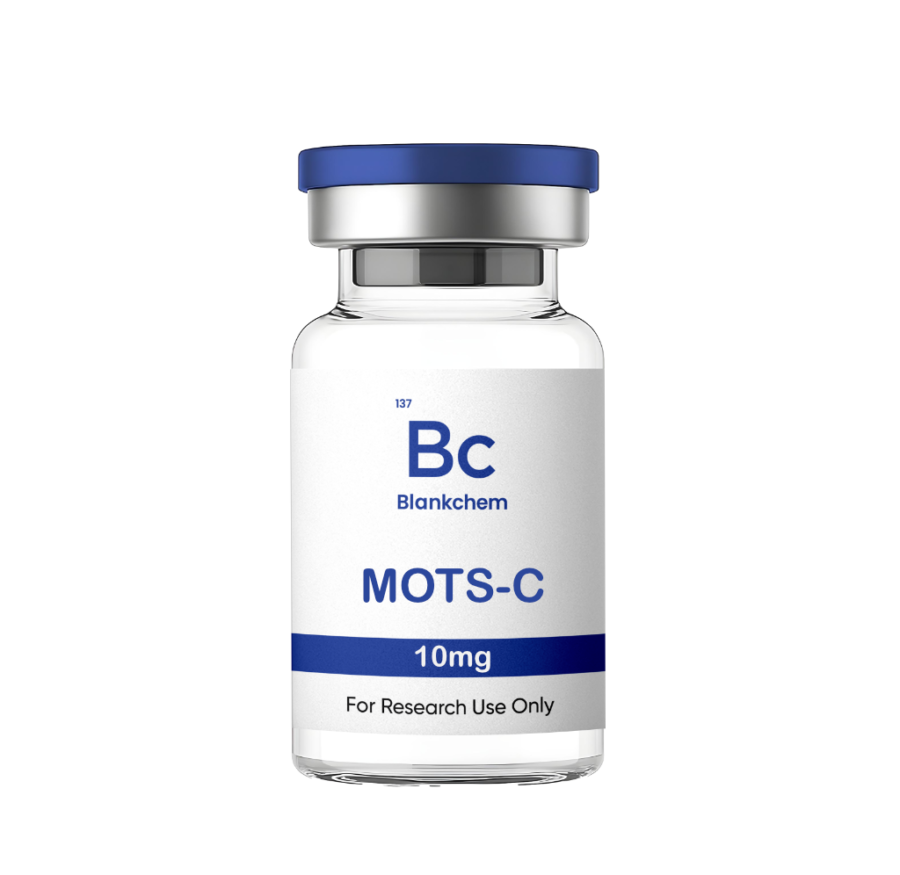
Each vial contains 10mg of lyophilized MOTS-c with pharmaceutical-grade mannitol as a lyoprotectant. Independently tested for purity and identity. Full COA available via our batch lookup tool.
For laboratory research purposes only. Not for human consumption. Research use only.
MOTS-c (Mitochondrial Open Reading Frame of the Twelve S rRNA-c) is a 16 amino acid peptide encoded by the mitochondrial genome — specifically by an open reading frame within the 12S ribosomal RNA gene. It belongs to a newly identified class of signaling molecules called mitochondrial-derived peptides (MDPs), which are small bioactive peptides produced directly by mitochondria that function as intercellular and systemic signaling molecules. MOTS-c was first identified and characterized in 2015, and its discovery fundamentally expanded the scientific understanding of mitochondrial function — establishing that mitochondria are not merely energy-producing organelles but active participants in systemic metabolic regulation through peptide signaling.
MOTS-c’s significance lies in both its origin and its documented biological activity. As a mitochondrial-encoded peptide, it represents a direct communication channel between mitochondrial metabolic status and systemic cellular function — a signaling axis that was largely unrecognized prior to its discovery. Research has documented MOTS-c’s ability to translocate from mitochondria to the nucleus in response to metabolic stress, where it directly regulates gene expression related to glucose metabolism and antioxidant defense. This mitochondria-to-nucleus signaling capability makes MOTS-c a uniquely valuable research tool for studying mitochondrial-nuclear crosstalk and its downstream effects on cellular metabolism.
Published research in rodent models has extensively documented MOTS-c’s effects on glucose metabolism and insulin sensitivity. Studies have demonstrated that MOTS-c activates the AMPK pathway — a master energy-sensing kinase that regulates glucose uptake and fatty acid oxidation — in skeletal muscle tissue. Animal model research has documented significant improvements in insulin sensitivity and glucose tolerance in subjects receiving MOTS-c, with researchers identifying its interaction with the folate cycle and its capacity to regulate the AICAR pathway as key mechanistic components. These findings have positioned MOTS-c as one of the most studied peptides in metabolic research examining mitochondrial regulation of glucose homeostasis.
AMP-activated protein kinase (AMPK) is a highly conserved cellular energy sensor that monitors the AMP-to-ATP ratio within cells and activates metabolic responses when energy levels are low. AMPK activation triggers a cascade of metabolic adaptations including increased glucose uptake, enhanced fatty acid oxidation, mitochondrial biogenesis, and suppression of energy-consuming biosynthetic pathways. It is one of the most studied metabolic signaling kinases in modern biochemistry, with published research linking its activation to improved metabolic function across a wide range of laboratory models. MOTS-c’s documented capacity to activate AMPK in skeletal muscle has made it a compound of significant research interest for studies examining mitochondrial regulation of whole-body energy metabolism.
One of the most compelling areas of MOTS-c research involves its relationship with physical exercise. Published studies have documented that MOTS-c levels in plasma increase in response to exercise in both animal and human subjects, leading researchers to characterize it as an exercise mimetic peptide — a compound that activates some of the same cellular pathways engaged during physical activity. Rodent studies have examined MOTS-c’s effects on skeletal muscle metabolism, mitochondrial function, and exercise capacity, with researchers documenting improvements in physical performance markers and metabolic efficiency in animal subjects. This exercise-related activity has made MOTS-c a subject of significant interest in exercise physiology and metabolic research.
MOTS-c has attracted substantial interest in aging and longevity research due to the observed decline in its plasma levels with age in both animal and human subjects. Published research has examined its effects in aged animal models, with studies documenting improvements in metabolic markers, physical function, and insulin sensitivity in older subjects receiving MOTS-c. Research has also investigated the relationship between MOTS-c levels and longevity in human population studies, with findings suggesting an association between higher circulating MOTS-c levels and healthy aging phenotypes. These findings have positioned MOTS-c as one of the most actively studied compounds at the intersection of mitochondrial biology and aging research.
Research has examined MOTS-c’s role in cellular stress response, specifically its capacity to translocate to the nucleus under conditions of metabolic stress where it functions as a transcriptional regulator. Studies have documented its activation of antioxidant defense genes and its role in regulating the integrated stress response — a cellular program activated in response to a wide range of stressors including oxidative stress, nutrient deprivation, and mitochondrial dysfunction. This stress-responsive behavior has made MOTS-c a valuable research tool for studying mitochondrial stress signaling and its downstream effects on cellular survival and metabolic adaptation.
MOTS-c is soluble in bacteriostatic water, which is the most commonly cited solvent in published research protocols for peptides of this class. Researchers should consult compound-specific solubility data and published literature to confirm the appropriate solvent and preparation methodology for their specific research application.
Every batch is independently tested for purity and identity prior to shipping. Full COA data including purity percentage and testing methodology is available via our batch lookup tool using your batch number.
MOTS-c arrives as a white to off-white lyophilized powder in a sterile sealed vial. Pharmaceutical-grade mannitol is included as a lyoprotectant, giving the powder visible bulk at the bottom of the vial. This is expected and normal.
Lyophilized (unprepared) vials: In a cool, dry environment away from direct light and heat, lyophilized vials maintain compound integrity for approximately six months to one year. For extended preservation, deep freezer storage under stable conditions without repeated temperature cycling is appropriate. Published stability data for lyophilized peptides of this class suggests integrity can be maintained for several years under optimal frozen storage conditions — researchers should consult current literature for compound-specific stability data. Avoid repeated temperature cycling as it accelerates degradation regardless of storage temperature.
Once prepared for laboratory use, refrigerated storage is standard protocol. Research and stability studies indicate that prepared peptide solutions of this class typically maintain peak integrity for approximately 28 to 40 days under refrigerated conditions. Beyond this window researchers should account for potential degradation when designing experimental protocols.
For laboratory research purposes only. Not for human consumption. Research use only.