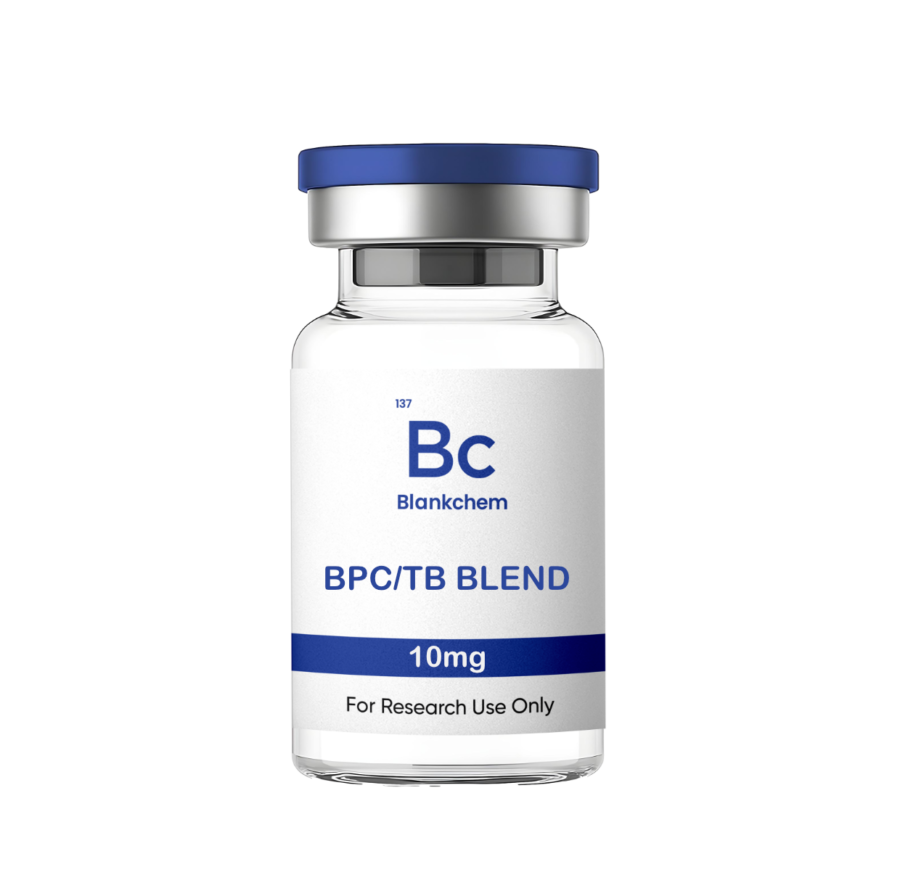
BPC/TB Blend (Wolverine)
Studied for cellular repair and regeneration
This lyophilized peptide must be reconstituted with RECON-S before use in research. Most customers forget to add it — don't get stuck waiting for a second order.
Add Reconstitution SolutionBPC/TB Blend — Wolverine
The Wolverine blend combines two of the most extensively researched peptides in modern peptide science into a single, precision-formulated vial. BPC-157 and TB-500 are among the most frequently co-studied compounds in peer-reviewed animal research, making this blend a logical and efficient choice for laboratories investigating cellular signaling, tissue modeling, and angiogenic pathways simultaneously.
Each vial is formulated at a 50/50 ratio — reflecting the most commonly referenced ratio in published animal research combining these two compounds. Available in 10mg (5mg BPC-157 / 5mg TB-500) and 20mg (10mg BPC-157 / 10mg TB-500) configurations.
BPC-157 is a 15 amino acid pentadecapeptide with over 100 published studies examining its interaction with the nitric oxide system, VEGF signaling, fibroblast activity, and neurotransmitter modulation. TB-500, a synthetic analog of the active region of Thymosin Beta-4, has been studied extensively for its role in actin upregulation, endothelial cell migration, and systemic cellular activity. Together, their non-overlapping mechanisms make them a compelling subject of combined research.
Every batch is independently tested for purity and identity prior to shipping. Full COA data is available via our batch lookup tool.
Supplied as a lyophilized powder with pharmaceutical-grade mannitol as a lyoprotectant. Sterile sealed vial. Ships without temperature excursion.
For laboratory research purposes only. Not for human consumption. Research use only.
Storage conditions depend on whether the compound remains in lyophilized form or has been prepared for research use.
Lyophilized (unprepared) vials:
In a cool, dry environment away from direct light and heat, lyophilized vials maintain compound integrity for approximately six months to one year. For extended preservation, deep freezer storage is appropriate — under stable frozen conditions without repeated temperature cycling, published stability data for lyophilized peptides of this class suggests integrity can be maintained for several years, though researchers should consult current literature for compound-specific stability data as findings vary. Avoid repeatedly removing vials from frozen storage, as temperature cycling accelerates degradation regardless of storage temperature.
Reconstituted (prepared for research) vials:
Once a vial has been prepared for laboratory use, refrigerated storage is standard protocol. Research and stability studies indicate that prepared peptide solutions of this class typically maintain peak integrity for approximately 28 to 40 days under refrigerated conditions. Beyond this window, researchers should account for potential degradation when designing experimental protocols. Freezing a prepared solution is not recommended as it can affect peptide structure.
Each vial contains BPC-157 and TB-500 in a 50/50 split. The 10mg vial contains 5mg BPC-157 and 5mg TB-500. The 20mg vial contains 10mg BPC-157 and 10mg TB-500. These two peptides are among the most co-researched compounds in peptide science, so we combined them into a single vial to simplify laboratory workflows.
BPC-157 (Body Protection Compound 157) is a 15 amino acid pentadecapeptide sequence derived from a naturally occurring protein found in human gastric juice. It is one of the most studied synthetic peptides in modern research. Animal studies have investigated its interaction with the nitric oxide system, its influence on growth hormone receptors, its effect on tendon and ligament fibroblast activity, and its role in modulating dopamine and serotonin activity in the central nervous system. Research has also examined its interaction with the VEGF (Vascular Endothelial Growth Factor) pathway, which plays a central role in angiogenesis.
TB-500 is a synthetic analog of the 17 amino acid active region of Thymosin Beta-4, a peptide found in high concentrations in blood platelets, wound fluid, and most human and animal cells. Thymosin Beta-4 is encoded by the TMSB4X gene and is recognized as one of the most abundant and highly conserved peptides in the human body. Research on TB-500 has centered on its ability to upregulate actin — a structural protein critical to cell motility and differentiation — and its role in promoting endothelial cell migration and blood vessel formation. It has been studied extensively in models involving cardiac tissue, skeletal muscle, and the central nervous system.
BPC-157 and TB-500 operate through distinct but complementary mechanisms. BPC-157 research focuses on localized cellular signaling, fibroblast activity, and neurotransmitter modulation. TB-500 research focuses on systemic upregulation of actin and endothelial migration. Because their mechanisms are non-overlapping, researchers frequently combine them in animal models to observe whether their effects on cellular repair and tissue modeling are additive or synergistic. The 50/50 ratio used in this blend reflects the most commonly cited ratio in peer-reviewed animal research combining these two compounds.
BPC-157 has been the subject of over 100 published studies, the majority conducted in rodent models. Key research areas include tendon-to-bone healing, intestinal anastomosis, inflammatory bowel models, traumatic brain injury, and peripheral nerve injury. Studies have documented its interaction with the NO-system, VEGF signaling, and its apparent ability to counteract the effects of NSAIDs and alcohol on gastric tissue in animal models.
TB-500 research has examined its role in cardiac repair following induced myocardial infarction in animal models, corneal repair, hair follicle stimulation, and neurological recovery following stroke models. A key mechanism studied is its ability to sequester G-actin, preventing polymerization and facilitating cell migration — a process critical to tissue remodeling in research contexts.
Every batch is independently tested prior to shipping. Purity data, testing methodology, and batch-specific results are available via the COA Lookup tool on our website. Enter your batch number to pull the full report.
The blend arrives as a white to off-white lyophilized powder in a sterile, sealed vial. Mannitol is included as a pharmaceutical-grade lyoprotectant and bulking agent — it protects compound integrity during the freeze-drying process and gives the powder visible mass at the bottom of the vial. This is expected and normal.
Lyophilized peptides are significantly more stable than liquid preparations. Removing moisture halts degradation pathways that would otherwise reduce compound integrity over time, particularly during shipping and storage. It is the industry standard format for research-grade peptides.