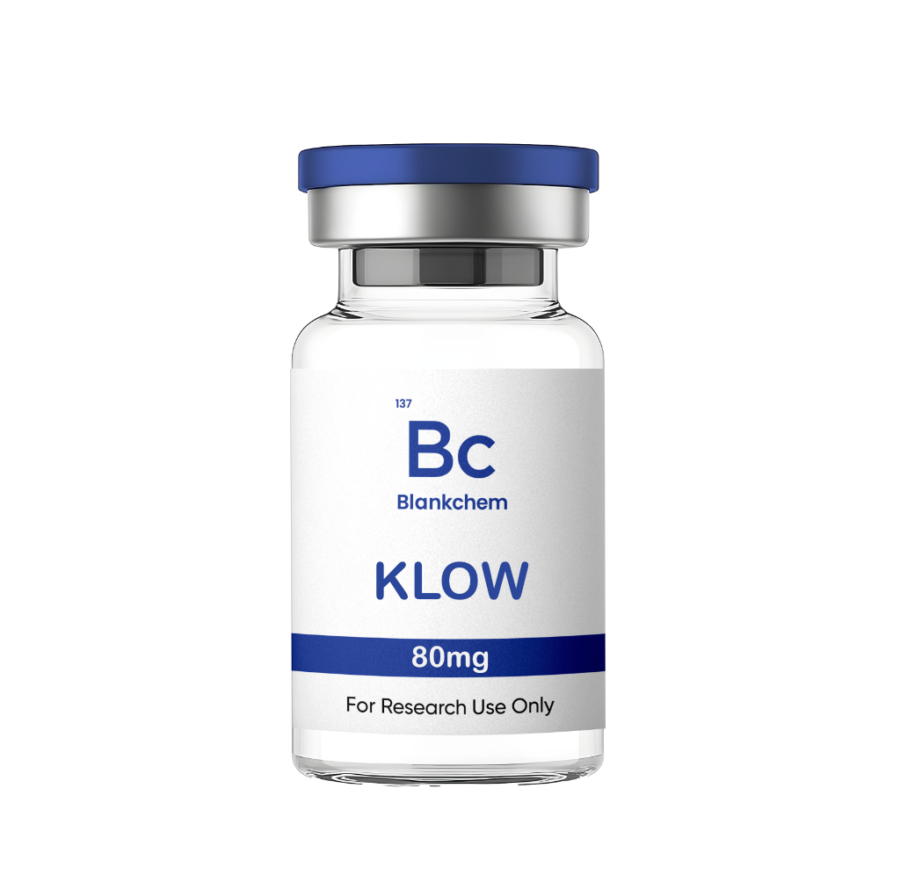
KLOW
Quad Peptide Blend | Cellular Repair & Anti-Inflammatory Research
This lyophilized peptide must be reconstituted with RECON-S before use in research. Most customers forget to add it — don't get stuck waiting for a second order.
Add Reconstitution SolutionKLOW Blend (GHK-Cu/BPC-157/TB-500/KPV) — 80mg
The KLOW Blend is a precisely formulated quad-peptide complex combining four of the most extensively researched compounds in modern peptide science into a single lyophilized vial. GHK-Cu, BPC-157, TB-500, and KPV represent four distinct but mechanistically complementary research compounds — a copper peptide complex with documented roles in extracellular matrix remodeling and gene expression modulation, a gastric-derived pentadecapeptide with an extensive body of cellular signaling research, a synthetic Thymosin Beta-4 fragment with documented pro-angiogenic and actin-regulatory activity, and a potent anti-inflammatory tripeptide derived from alpha-MSH with documented antimicrobial and gut mucosal research applications. Each compound operates through distinct receptor pathways and cellular mechanisms, making the KLOW Blend a uniquely comprehensive research tool for laboratories investigating the intersection of tissue modeling, angiogenesis, extracellular matrix remodeling, and inflammatory pathway regulation simultaneously.
Formulated at 50mg GHK-Cu / 10mg BPC-157 / 10mg TB-500 / 10mg KPV — 80mg total per vial.
Each vial contains pharmaceutical-grade mannitol as a lyoprotectant. Independently tested for purity and identity. Full COA available via our batch lookup tool.
For laboratory research purposes only. Not for human consumption. Research use only.
The KLOW Blend is a quad-peptide research compound combining GHK-Cu (Glycyl-L-histidyl-L-lysine copper complex), BPC-157 (Body Protection Compound 157), TB-500 (Thymosin Beta-4 fragment), and KPV (Lysine-Proline-Valine) into a single lyophilized vial. Each compound has an independent body of published research supporting its biological activity, and their mechanistic non-overlap makes this blend a compelling tool for researchers studying multiple cellular pathways simultaneously. The blend is formulated at 50mg GHK-Cu / 10mg BPC-157 / 10mg TB-500 / 10mg KPV, reflecting a ratio designed to balance the established research profiles of each compound within a single preparation.
KPV (Lysine-Proline-Valine) is a tripeptide derived from the C-terminal region of alpha-Melanocyte Stimulating Hormone (α-MSH) — a naturally occurring peptide hormone produced by the pituitary gland with well-documented anti-inflammatory and immunomodulatory properties. KPV isolates and replicates the active anti-inflammatory region of α-MSH, making it a precise research tool for studying α-MSH-mediated inflammatory pathway regulation without the broader hormonal effects of the full-length peptide. Published research has examined KPV’s effects on NF-κB signaling — a master regulator of inflammatory gene expression — its antimicrobial activity against a range of bacterial strains in laboratory models, and its effects on intestinal epithelial cell function in gut mucosal research models. Its inclusion in the KLOW Blend adds an anti-inflammatory and antimicrobial research dimension that complements the tissue modeling and angiogenic activity of the other three compounds.
KPV exerts its anti-inflammatory effects primarily through the melanocortin receptor 1 (MC1R), the same receptor through which full-length α-MSH mediates its immunomodulatory activity. MC1R is expressed on immune cells including macrophages and dendritic cells, as well as on intestinal epithelial cells — a distribution that has driven research interest in KPV’s role in gut mucosal inflammation models. MC1R activation suppresses NF-κB signaling and downstream pro-inflammatory cytokine production, providing a mechanistic basis for the anti-inflammatory effects documented in KPV research. MC1R’s expression on intestinal epithelial cells has also made KPV a subject of significant interest in inflammatory bowel disease research models.
Published research has examined KPV’s antimicrobial properties in laboratory models, with studies documenting activity against both gram-positive and gram-negative bacterial strains in controlled in vitro settings. The antimicrobial mechanism is believed to be distinct from its anti-inflammatory MC1R-mediated pathway, with researchers proposing direct membrane disruption as a contributing mechanism in some bacterial models. KPV’s combination of anti-inflammatory and antimicrobial activity in a single tripeptide has made it a compound of growing research interest in models examining the intersection of inflammation and microbial defense in mucosal tissue.
GHK-Cu, BPC-157, TB-500, and KPV operate through four distinct but complementary mechanisms that collectively span a broad range of cellular research interests. GHK-Cu’s primary research focus centers on extracellular matrix remodeling, collagen synthesis, and gene expression modulation through its copper-dependent enzymatic interactions. BPC-157’s research profile covers nitric oxide system modulation, VEGF signaling, fibroblast activity, and neurotransmitter regulation. TB-500’s documented mechanism centers on actin sequestration, endothelial cell migration, and systemic pro-angiogenic activity. KPV contributes anti-inflammatory MC1R-mediated pathway modulation and antimicrobial activity. Because these four mechanisms are non-overlapping, combining them into a single research preparation allows laboratories to investigate their collective and potentially additive effects on cellular repair, tissue modeling, and inflammatory regulation simultaneously.
KPV has attracted significant research interest in gut mucosal biology, with published studies examining its effects on intestinal epithelial cell survival, barrier function, and inflammatory marker expression in colitis animal models. Research has documented KPV’s capacity to reduce pro-inflammatory cytokine production — including TNF-α and IL-6 — in intestinal tissue models, with researchers attributing these effects to MC1R-mediated NF-κB suppression in epithelial and immune cells. BPC-157’s well-documented activity in gut and gastrointestinal research models makes the combination of BPC-157 and KPV within the KLOW Blend particularly relevant for researchers investigating inflammatory pathway regulation in intestinal tissue contexts.
Every batch is independently tested for purity and identity prior to shipping. Full COA data including purity percentage and testing methodology is available via our batch lookup tool using your batch number.
The KLOW Blend arrives as a blue to blue-green lyophilized powder in a sterile sealed vial — the characteristic color of the GHK-Cu copper complex confirms compound integrity. Pharmaceutical-grade mannitol is included as a lyoprotectant. This is expected and normal.
Lyophilized (unprepared) vials: Refrigerated storage between 35.6–46.4°F (2–8°C) is recommended for the KLOW Blend. The GHK-Cu component makes refrigeration the preferred storage condition even for short-term storage. Avoid repeated temperature cycling as it accelerates degradation regardless of storage temperature. For long-term preservation, stable frozen storage without repeated temperature cycling maintains compound integrity — researchers should consult current published stability literature for compound-specific guidance.
Once prepared for laboratory use, refrigerated storage is standard protocol. Research and stability studies indicate that prepared peptide solutions of this class typically maintain peak integrity for approximately 28 to 40 days under refrigerated conditions. Beyond this window researchers should account for potential degradation when designing experimental protocols.
For laboratory research purposes only. Not for human consumption. Research use only.