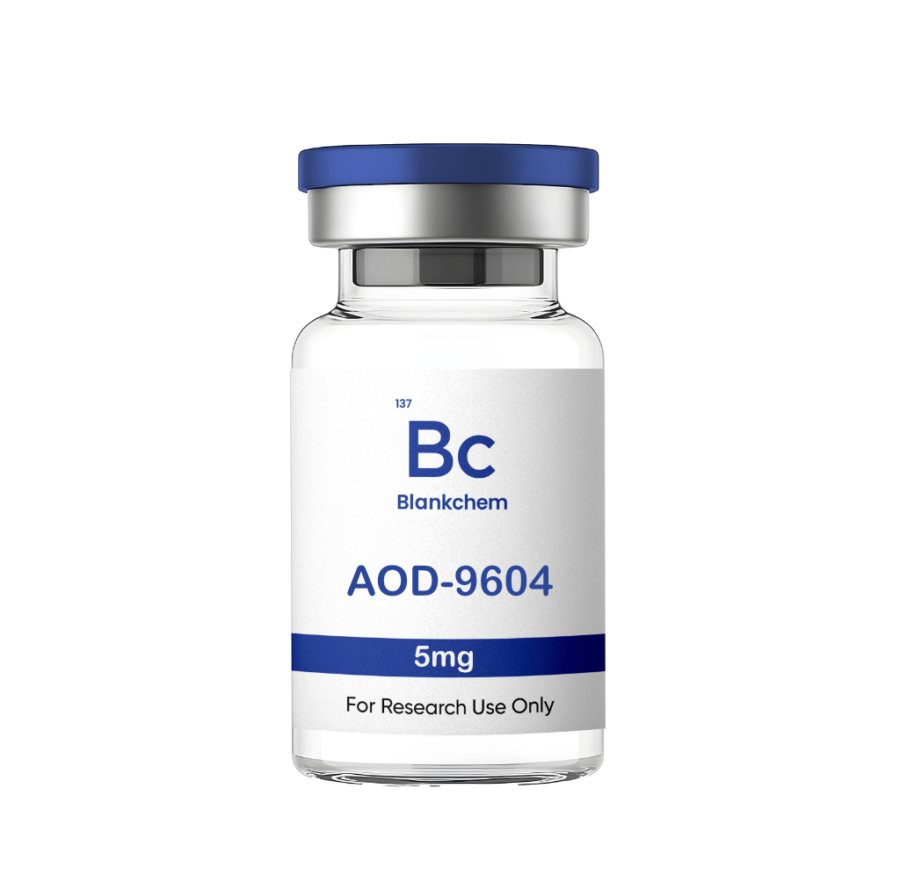
AOD-9604
Modified GH Fragment | Lipolytic Research Peptide
This lyophilized peptide must be reconstituted with RECON-S before use in research. Most customers forget to add it — don't get stuck waiting for a second order.
Add Reconstitution SolutionAOD-9604 — 5mg
AOD-9604 is a synthetic modified fragment of human growth hormone (hGH), corresponding to amino acids 176-191 of the hGH C-terminus with an additional tyrosine residue added at the N-terminus. Originally developed and studied by Monash University in Australia, AOD-9604 was specifically engineered to isolate the lipolytic — fat metabolizing — region of the growth hormone molecule while eliminating the insulin-like effects associated with full-length hGH. This makes it one of the most precise research tools available for studying growth hormone’s role in lipid metabolism independent of its anabolic and glucose-regulatory effects. Unlike full-length growth hormone, AOD-9604 does not bind to the growth hormone receptor — instead it appears to operate through a distinct mechanism involving beta-3 adrenergic receptors, making it a mechanistically unique compound in the GH-related peptide research landscape. Published research has examined its effects on adipose tissue lipolysis, fat oxidation, and lipid metabolism in both animal and human research models, with an extensive body of preclinical literature establishing it as one of the most studied GH-derived fragments in metabolic research.
Each vial contains 5mg of lyophilized AOD-9604 with pharmaceutical-grade mannitol as a lyoprotectant. Independently tested for purity and identity. Full COA available via our batch lookup tool.
For laboratory research purposes only. Not for human consumption. Research use only.
AOD-9604 is a synthetic peptide fragment derived from the C-terminus of human growth hormone, corresponding to amino acids 176-191 of the hGH sequence with an additional tyrosine residue at the N-terminus. It was originally developed at Monash University in Australia as part of a research program aimed at isolating the fat-metabolizing properties of growth hormone from its other biological effects. The name AOD stands for Anti-Obesity Drug — reflecting its original research designation — though it is supplied by BlankChem strictly as a research compound for laboratory use. Its structural derivation from hGH combined with its distinct receptor interaction profile makes it one of the most mechanistically interesting peptides in the GH-related research landscape.
Full-length human growth hormone is a 191 amino acid protein that exerts a broad range of biological effects through binding to the growth hormone receptor — including anabolic effects on muscle and bone, insulin-like effects on glucose metabolism, and lipolytic effects on adipose tissue. AOD-9604 isolates only the 16 amino acid C-terminal fragment responsible for GH’s lipolytic activity. Critically, AOD-9604 does not bind to the growth hormone receptor and therefore does not produce the insulin-like or anabolic effects associated with full-length hGH. This receptor selectivity makes AOD-9604 a uniquely precise research tool for studying the lipolytic component of growth hormone biology in isolation.
Unlike full-length growth hormone which acts through the GH receptor, research has suggested that AOD-9604 operates through a mechanism involving beta-3 adrenergic receptors — receptors expressed predominantly in adipose tissue that regulate lipolysis and thermogenesis. This mechanistic distinction from full-length hGH is significant from a research standpoint as it positions AOD-9604 as a tool for studying adrenergic-mediated lipolysis rather than GH receptor-mediated metabolic effects. Researchers should consult current published literature for compound-specific mechanistic data as this remains an active area of investigation.
Preclinical studies in rodent and large animal models have extensively examined AOD-9604’s effects on lipid metabolism and body composition. Published research has documented significant reductions in body fat in obese animal subjects receiving AOD-9604, with researchers noting stimulation of lipolysis — the breakdown of stored fat — and inhibition of lipogenesis — the formation of new fat — in adipose tissue models. Studies have also examined its effects on fat oxidation rates and resting metabolic markers in animal subjects. Notably, these lipolytic effects were documented without the hyperglycemic effects associated with full-length growth hormone administration in the same models, confirming the functional separation of GH’s lipolytic and insulin-like properties in AOD-9604 research.
AOD-9604 belongs to a class of research compounds derived from fragments of the human growth hormone sequence, each engineered to isolate specific regions of biological activity. Research on GH fragments has been valuable in mapping the structure-activity relationships of growth hormone — identifying which regions of the 191 amino acid sequence are responsible for specific downstream effects. AOD-9604’s C-terminal fragment has been the most extensively studied of these fragments, with its lipolytic activity first documented in the 1990s and subsequently investigated across multiple research programs. Its research history makes it one of the better characterized GH-derived peptide fragments in published literature.
AOD-9604 is most commonly prepared using acetic acid solution in published research protocols — an acidic solvent environment is required for proper dissolution of this compound. BlankChem supplies 0.6% acetic acid solution specifically for this purpose. Researchers should consult compound-specific solubility data and published literature to confirm the appropriate solvent and preparation methodology for their specific research application.
Every batch is independently tested for purity and identity prior to shipping. Full COA data including purity percentage and testing methodology is available via our batch lookup tool using your batch number.
AOD-9604 arrives as a white to off-white lyophilized powder in a sterile sealed vial. Pharmaceutical-grade mannitol is included as a lyoprotectant, giving the powder visible bulk at the bottom of the vial. This is expected and normal.
Lyophilized (unprepared) vials: In a cool, dry environment away from direct light and heat, lyophilized vials maintain compound integrity for approximately six months to one year. For extended preservation, deep freezer storage under stable conditions without repeated temperature cycling is appropriate. Published stability data for lyophilized peptides of this class suggests integrity can be maintained for several years under optimal frozen storage conditions — researchers should consult current literature for compound-specific stability data. Avoid repeated temperature cycling as it accelerates degradation regardless of storage temperature.
Once prepared for laboratory use, refrigerated storage is standard protocol. Research and stability studies indicate that prepared peptide solutions of this class typically maintain peak integrity for approximately 28 to 40 days under refrigerated conditions. Beyond this window researchers should account for potential degradation when designing experimental protocols.
For laboratory research purposes only. Not for human consumption. Research use only.