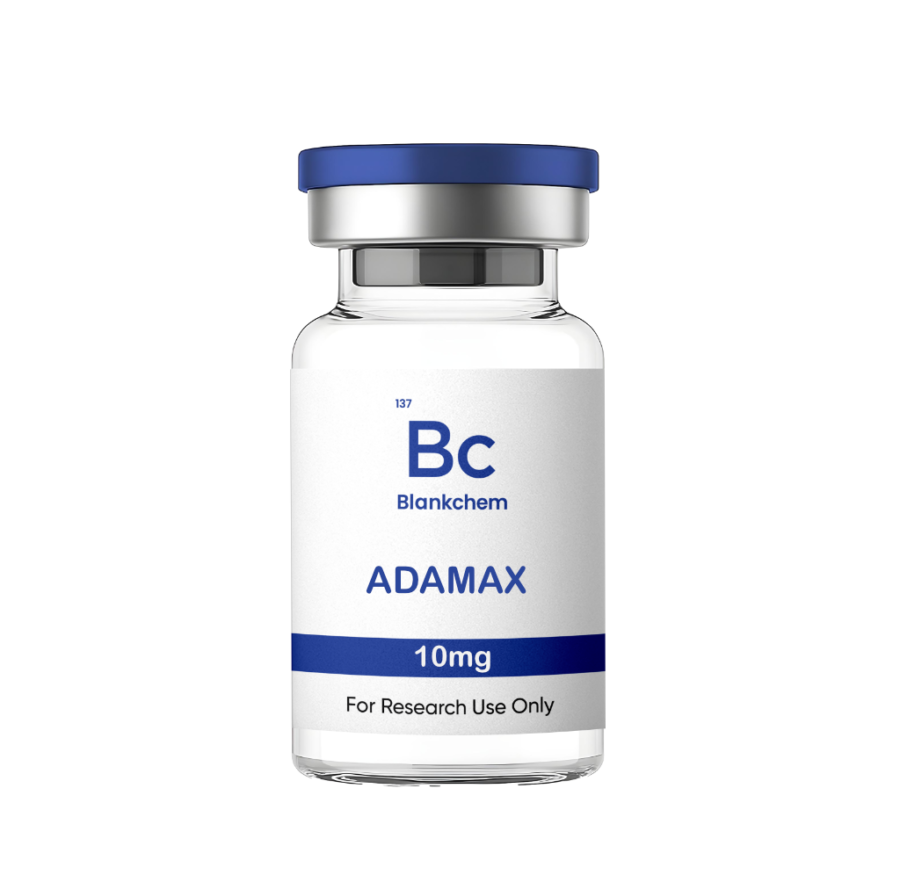
Adamax
Synthetic Neuro-Peptide
This lyophilized peptide must be reconstituted with RECON-S before use in research. Most customers forget to add it — don't get stuck waiting for a second order.
Add Reconstitution SolutionAdamax
Adamax is a highly modified synthetic neuropeptide analog derived from the ACTH(4-10) framework — the same structural foundation as Semax — engineered with three specific modifications designed to dramatically enhance its research utility. An adamantyl group addition, an N-acetyl modification, and a C-terminal amide collectively increase the compound’s lipophilicity, enzymatic resistance, and blood-brain barrier permeability compared to its parent structure. These structural refinements make Adamax one of the more sophisticated neuropeptide research tools available, with research interest centered on its potent modulation of BDNF expression, TrkB receptor signaling, and its role as a model compound in neuroprotection and neurogenesis research.
Primary Research Applications: Adamax is currently investigated across four core areas of neurobiological research. Neurotrophic modulation studies examine its capacity to upregulate BDNF expression and characterize downstream cellular effects through the TrkB signaling cascade. Neuroprotection research utilizes Adamax in neural cell line models to investigate cellular survival mechanisms and stress resistance pathways under controlled laboratory conditions. Receptor signaling kinetic studies evaluate TrkB binding affinity and the dynamics of intracellular cascade activation following receptor engagement. Neurogenic pathway research maps cellular responses associated with synaptic plasticity and structural remodeling in in vitro experimental models.
Each vial contains 10mg of lyophilized Adamax with pharmaceutical-grade mannitol as a lyoprotectant. Independently tested for purity and identity. Full COA available via our batch lookup tool.
For laboratory research purposes only. Not for human consumption. Research use only.
Adamax is a synthetic neuropeptide analog structurally derived from the ACTH(4-10) peptide fragment — a sequence of the adrenocorticotropic hormone that has been studied extensively for its neurobiological activity independent of its adrenal effects. Adamax shares its foundational structure with Semax, a well-researched neuropeptide analog, but incorporates three additional structural modifications — an adamantyl group, an N-acetyl modification, and a C-terminal amide — that significantly alter its pharmacokinetic profile and receptor interaction characteristics. These modifications place Adamax among the most structurally refined synthetic neuropeptides currently available for laboratory research.
The adamantyl group is a rigid, cage-like carbon structure added to enhance lipophilicity — the compound’s affinity for lipid-rich environments. In neurological research contexts this is significant because increased lipophilicity is associated with enhanced permeability across the blood-brain barrier, allowing greater central nervous system tissue availability in research models. The N-acetyl modification adds an acetyl group to the peptide’s N-terminus, providing resistance to aminopeptidase enzymes that would otherwise rapidly degrade the compound in biological environments. The C-terminal amide replaces the standard carboxyl group at the peptide’s C-terminus, providing additional resistance to carboxypeptidase degradation. Together these three modifications produce a compound with substantially greater stability and central nervous system accessibility than its parent ACTH(4-10) structure.
Brain-Derived Neurotrophic Factor (BDNF) is a member of the neurotrophin family — a class of proteins that support the survival, development, and function of neurons. BDNF is one of the most extensively studied neurotrophins in modern neuroscience, with published research documenting its critical role in neuronal plasticity, synaptogenesis, long-term potentiation, and neuroprotection against cellular stress. It is produced throughout the central and peripheral nervous system and acts primarily through the TrkB receptor. Research has consistently linked BDNF expression levels to neurological function across a wide range of animal models, making compounds that modulate BDNF expression — such as Adamax — highly valuable tools in neurobiological research.
TrkB (Tropomyosin receptor kinase B) is the primary high-affinity receptor through which BDNF exerts its neurobiological effects. It is a receptor tyrosine kinase expressed broadly throughout the central and peripheral nervous system. TrkB activation initiates intracellular signaling cascades including the MAPK/ERK pathway, the PI3K/Akt pathway, and the PLCγ pathway — all of which have established roles in neuronal survival, synaptic plasticity, and cellular differentiation in published neuroscience literature. Research on Adamax has focused on its capacity to modulate TrkB signaling activity, making it a compound of significant interest in studies examining neurotrophin receptor dynamics and downstream neuroprotective signaling cascades.
In vitro and animal model research on Adamax and its structural predecessors has examined its effects in neuroprotection contexts — specifically its capacity to support neuronal survival under conditions of cellular stress, oxidative damage, and excitotoxicity in laboratory models. Studies examining ACTH(4-10) derived analogs in rodent models have documented effects on cognitive performance markers, neuronal resilience, and BDNF expression levels. Adamax’s enhanced structural stability and lipophilicity compared to earlier analogs in this class have made it a subject of growing research interest for studies requiring sustained central nervous system activity in experimental models.
Semax is a well-established synthetic neuropeptide analog also derived from the ACTH(4-10) framework, developed in Russia and studied extensively since the 1980s in both animal and human research settings. Semax research has documented effects on BDNF expression, cognitive markers, and neuroprotection in animal models. Adamax can be understood as a next-generation structural refinement of the Semax framework — incorporating the adamantyl group, N-acetyl modification, and C-terminal amide to address the stability and lipophilicity limitations of its predecessor. Researchers familiar with the Semax literature will find Adamax a mechanistically adjacent but structurally superior research tool for studies requiring enhanced CNS bioavailability and enzymatic stability.
Research on ACTH(4-10) derived neuropeptide analogs including Semax has examined their effects on neurogenesis — the process by which new neurons are formed from neural stem cells — in adult rodent models. Studies have documented upregulation of BDNF and other neurotrophic factors in hippocampal tissue following administration of analogs in this class, with researchers noting associated changes in markers of synaptic plasticity and neural progenitor cell activity. Adamax’s enhanced structural profile makes it a compelling research tool for studies building on this existing neurogenesis literature.
Adamax is soluble in bacteriostatic water. Researchers should consult compound-specific solubility data and published literature to confirm the appropriate solvent and preparation methodology for their specific research application.
Every batch is independently tested for purity and identity prior to shipping. Full COA data including purity percentage and testing methodology is available via our batch lookup tool using your batch number.
Adamax arrives as a white to off-white lyophilized powder in a sterile sealed vial. Pharmaceutical-grade mannitol is included as a lyoprotectant, giving the powder visible bulk at the bottom of the vial. This is expected and normal.
In a cool, dry environment away from direct light and heat, lyophilized vials maintain compound integrity for approximately six months to one year. For extended preservation, deep freezer storage under stable conditions without repeated temperature cycling is appropriate. Published stability data for lyophilized peptides of this class suggests integrity can be maintained for several years under optimal frozen storage conditions — researchers should consult current literature for compound-specific stability data. Avoid repeated temperature cycling as it accelerates degradation regardless of storage temperature.
Once prepared for laboratory use, refrigerated storage is standard protocol. Research and stability studies indicate that prepared peptide solutions of this class typically maintain peak integrity for approximately 28 to 40 days under refrigerated conditions. Beyond this window researchers should account for potential degradation when designing experimental protocols.
For laboratory research purposes only. Not for human consumption. Research use only.