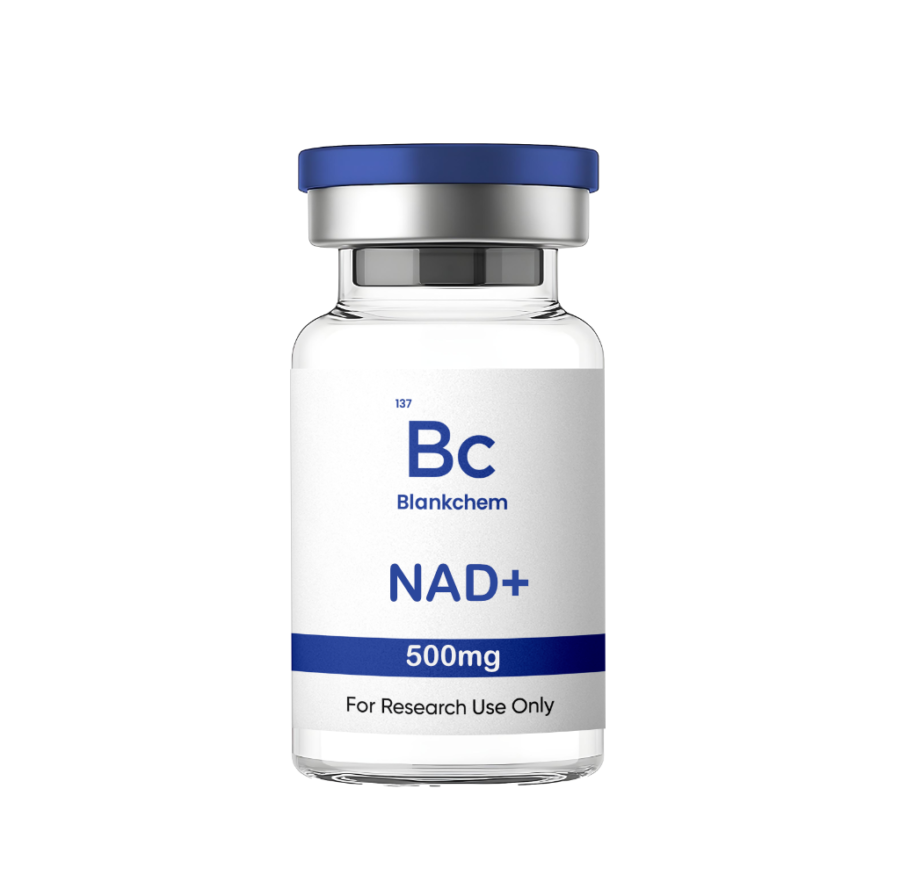
NAD+
Essential Coenzyme | Cellular Energy & Longevity Research
This lyophilized peptide must be reconstituted with RECON-S before use in research. Most customers forget to add it — don't get stuck waiting for a second order.
Add Reconstitution SolutionNAD+ (Nicotinamide Adenine Dinucleotide) — 500mg
NAD+ is one of the most fundamental coenzymes in all of biology — a molecule so central to cellular function that it is found in every living cell across virtually every known organism. Nicotinamide Adenine Dinucleotide participates as an essential electron carrier in cellular respiration, shuttling electrons through the mitochondrial oxidative phosphorylation chain to drive ATP production — the primary energy currency of the cell. Beyond its role in energy metabolism, NAD+ functions as a critical substrate for a broad class of enzymes including sirtuins, PARPs, and CD38 — enzymes with extensively documented roles in DNA repair, gene expression regulation, cellular stress response, and aging biology. Published research has consistently documented a significant age-related decline in intracellular NAD+ levels across multiple tissue types in both animal and human subjects, a finding that has driven an explosion of research interest in NAD+ biology over the past decade and positioned NAD+ restoration as one of the most actively studied interventions in longevity and metabolic research. BlankChem supplies NAD+ as a high-purity lyophilized research standard for controlled laboratory applications investigating cellular energy metabolism, mitochondrial function, sirtuin pathway activation, and DNA repair dynamics.
Each vial contains 500mg of lyophilized NAD+ with pharmaceutical-grade mannitol as a lyoprotectant. Independently tested for purity and identity. Full COA available via our batch lookup tool.
For laboratory research purposes only. Not for human consumption. Research use only.
NAD+ (Nicotinamide Adenine Dinucleotide) is a dinucleotide coenzyme composed of two nucleotides — one containing adenine and one containing nicotinamide — joined by a phosphate bridge. It exists in two primary forms in biological systems: NAD+ (oxidized) and NADH (reduced), and its ability to cycle between these two redox states makes it an essential electron carrier in cellular metabolism. NAD+ is found in every living cell and participates in hundreds of metabolic reactions, making it one of the most broadly active molecules in biochemistry. Its roles span cellular energy production, DNA repair, gene expression regulation, and intercellular signaling — a breadth of biological involvement that has made it a central subject of research across metabolic science, aging biology, and neuroscience.
NAD+ is an essential participant in the cellular respiration pathway — the process by which cells convert nutrients into usable energy in the form of ATP. In glycolysis and the citric acid cycle, NAD+ accepts electrons from metabolic intermediates, becoming NADH. This NADH then donates its electrons to the mitochondrial electron transport chain, driving ATP synthesis through oxidative phosphorylation. Without sufficient NAD+, this electron transfer cannot occur efficiently and cellular energy production is compromised. Research has documented that declining NAD+ levels in aging tissues correlate with reduced mitochondrial function and impaired cellular energy metabolism, establishing NAD+ availability as a rate-limiting factor in mitochondrial efficiency in aged animal models.
Sirtuins are a family of seven NAD+-dependent deacetylase enzymes (SIRT1-7) that regulate a broad network of cellular processes including DNA repair, gene expression, mitochondrial biogenesis, inflammation, and metabolic adaptation. Their activity is directly dependent on intracellular NAD+ availability — sirtuins consume NAD+ as a substrate in their enzymatic reactions, meaning that when NAD+ levels decline, sirtuin activity falls proportionally. Published research has extensively documented sirtuin involvement in aging biology, with studies in animal models demonstrating that maintaining sirtuin activity through NAD+ restoration extends healthspan markers and improves metabolic function. SIRT1 and SIRT3 in particular have been the subject of substantial research examining their roles in mitochondrial biogenesis, fatty acid oxidation, and cellular stress resistance.
PARP (Poly ADP-Ribose Polymerase) is a family of enzymes that play a critical role in DNA damage detection and repair. Like sirtuins, PARPs consume NAD+ as a substrate — in this case to synthesize poly ADP-ribose chains that signal DNA damage and recruit repair machinery. Under conditions of significant DNA damage, PARP activation can consume large quantities of NAD+, creating competition between DNA repair and other NAD+-dependent processes including sirtuin activity. Research has examined this PARP-sirtuin competition for NAD+ as a potential mechanism underlying the age-related decline in both DNA repair efficiency and sirtuin activity, positioning NAD+ availability as a central regulatory factor in cellular maintenance and genomic stability research.
One of the most consistently replicated findings in NAD+ research is the significant age-related decline in intracellular NAD+ levels across multiple tissue types. Published studies in rodent models have documented NAD+ level reductions of 50% or more in aged tissue compared to young subjects, with corresponding declines in mitochondrial function, sirtuin activity, and DNA repair capacity. Research restoring NAD+ levels in aged animal models has documented improvements in mitochondrial function, muscle endurance, cognitive markers, and metabolic efficiency — findings that have driven substantial interest in NAD+ biology as a longevity research framework. Studies in human subjects have confirmed the age-related NAD+ decline pattern observed in animal models, validating the translational relevance of preclinical NAD+ research.
NAD+ occupies a central position in the same research axis as two other BlankChem compounds — MOTS-c and 5-Amino-1MQ. MOTS-c, a mitochondrial-derived peptide, activates the AMPK pathway and has been studied for its role in maintaining mitochondrial NAD+ metabolism under metabolic stress conditions. 5-Amino-1MQ increases intracellular NAD+ availability by inhibiting NNMT — the enzyme that diverts nicotinamide away from NAD+ biosynthesis. NAD+ itself provides the direct substrate that both of these compounds ultimately seek to preserve or increase. Researchers studying the NAD+/mitochondrial axis frequently use these three compounds in combination or in comparative protocols to investigate different points of intervention along the same metabolic pathway.
CD38 is an enzyme expressed on the surface of immune cells and in multiple other tissue types that consumes NAD+ to produce cyclic ADP-ribose — a second messenger involved in calcium signaling. Research has documented a significant age-related increase in CD38 expression and activity, establishing it as a major contributor to the age-related decline in NAD+ levels alongside PARP activation and declining NAD+ biosynthesis. Studies examining CD38 inhibition as a strategy for preserving NAD+ levels have positioned it as an important research target in aging biology, and understanding CD38’s contribution to NAD+ consumption is a growing area of investigation in longevity research.
NAD+ research has expanded significantly into neurological contexts, with published studies examining its role in neuronal energy metabolism, axonal integrity, and neuroprotection. Research has documented NAD+’s involvement in the Wallerian degeneration pathway — the process by which damaged axons degenerate — with studies showing that maintaining NAD+ levels in neuronal models delays axonal degeneration markers. SIRT1 and SIRT3 activation through NAD+ has been studied in models of neurodegenerative conditions, with researchers documenting neuroprotective effects in animal models. These findings have positioned NAD+ as a compound of growing interest in neurological research examining the intersection of cellular energy metabolism and neuronal maintenance.
NAD+ is highly soluble in sterile water or bacteriostatic water. Bacteriostatic water is the most commonly cited solvent in published research protocols for NAD+ preparation. Researchers should note that NAD+ in solution is sensitive to pH extremes and prolonged exposure to light — preparation under controlled laboratory conditions and prompt use or refrigerated storage following preparation is standard protocol in published research.
Every batch is independently tested for purity and identity prior to shipping. Full COA data including purity percentage and testing methodology is available via our batch lookup tool using your batch number.
NAD+ arrives as a white to off-white lyophilized powder in a sterile sealed vial. Pharmaceutical-grade mannitol is included as a lyoprotectant, giving the powder visible bulk at the bottom of the vial. This is expected and normal.
Lyophilized (unprepared) vials: In a cool, dry environment away from direct light and heat, lyophilized vials maintain compound integrity for approximately six months to one year. NAD+ is particularly sensitive to light degradation — storage in amber or opaque containers away from any light source is strongly recommended. For extended preservation, deep freezer storage under stable conditions without repeated temperature cycling is appropriate. Avoid repeated temperature cycling as it accelerates degradation regardless of storage temperature.
Once prepared for laboratory use, refrigerated storage away from light is standard protocol. NAD+ in solution is more sensitive to degradation than most peptide compounds — research and stability studies indicate that prepared NAD+ solutions maintain peak integrity for a significantly shorter window than lyophilized peptides. Researchers should prepare only the volume required for immediate research use and consult current published stability literature for compound-specific guidance on solution stability timeframes.
For laboratory research purposes only. Not for human consumption. Research use only.