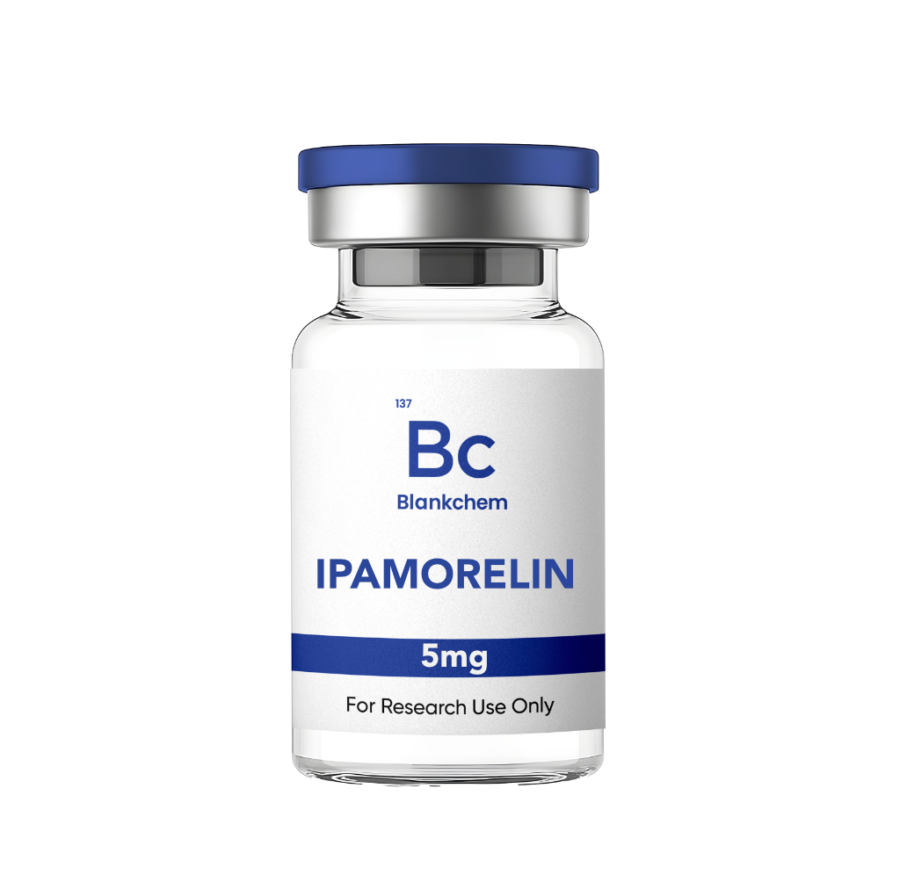
IPAMORELIN
Selective GHS-R1a agonist for pituitary GH secretion research.
This lyophilized peptide must be reconstituted with RECON-S before use in research. Most customers forget to add it — don't get stuck waiting for a second order.
Add Reconstitution SolutionIpamorelin is a synthetic pentapeptide growth hormone secretagogue (GHS) classified as a selective agonist at the growth hormone secretagogue receptor type 1a (GHS-R1a) — the same GPCR targeted by the endogenous hormone ghrelin. Originally developed by Novo Nordisk and formally described by Raun et al. in 1998, it was identified as the first truly selective growth hormone secretagogue — notable for its ability to stimulate GH release while leaving cortisol, prolactin, ACTH, FSH, LH, and TSH levels unaffected in preclinical models.
Its incorporation of non-natural amino acid residues — including alpha-aminoisobutyric acid (Aib) at the N-terminus, D-configured phenylalanine, and 2-naphthylalanine — contributes to enhanced receptor binding characteristics and resistance to enzymatic degradation, making it a structurally stable tool for GHS-R1a pathway research.
Ipamorelin is a synthetic pentapeptide and selective agonist at the ghrelin receptor (GHS-R1a), first described in 1998 by Novo Nordisk researchers. It is considered the first truly selective growth hormone secretagogue — meaning it stimulates GH release from the pituitary without meaningfully elevating cortisol, prolactin, or ACTH. This selectivity makes it a particularly clean research tool for isolating GH pathway activity in experimental models.
The key distinction is endocrine selectivity. GHRP-2 and GHRP-6 both stimulate GH release but also elevate cortisol and ACTH in preclinical models — introducing confounding variables in research. Ipamorelin does not meaningfully affect these hormones at research concentrations, nor does it significantly stimulate appetite the way GHRP-6 does via ghrelin receptor activation. This makes it the preferred compound when researchers need to study GH secretagogue activity in isolation.
Ipamorelin is a selective agonist at GHS-R1a — the growth hormone secretagogue receptor type 1a, also known as the ghrelin receptor. This is a G-protein coupled receptor expressed in the anterior pituitary and hypothalamus. Upon binding, it activates intracellular signaling cascades that trigger pulsatile GH secretion from somatotroph cells.
Yes. Preclinical research has also examined ipamorelin in gastrointestinal motility models — specifically gastroparesis — where GHS-R1a agonism has been shown to accelerate gastric emptying in animal studies. Additional research has looked at downstream effects on bone metabolism and body composition in rodent models, reflecting the broader physiological reach of the ghrelin receptor system.
No. Ipamorelin has been evaluated in Phase I and Phase II clinical trials but is not an approved pharmaceutical compound. BlankChem supplies Ipamorelin strictly as a research chemical for qualified laboratory use. It is not intended for human consumption or clinical application of any kind.