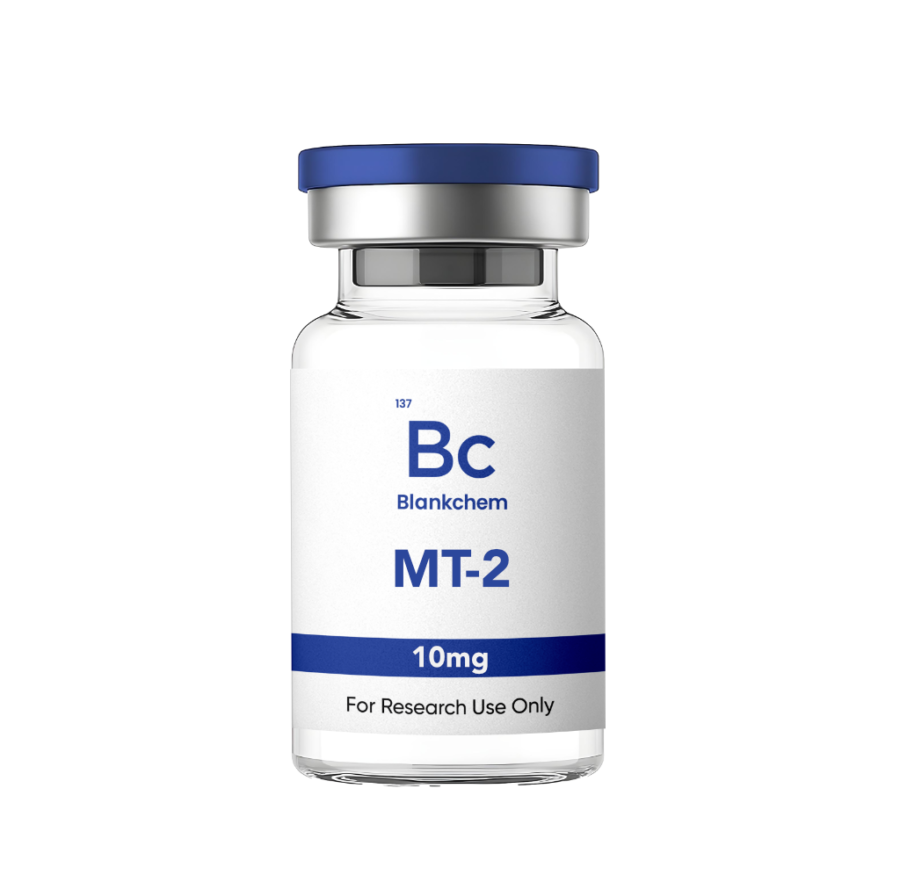
Melanotan II
Synthetic α-MSH analog for melanocortin receptor signaling research.
This lyophilized peptide must be reconstituted with RECON-S before use in research. Most customers forget to add it — don't get stuck waiting for a second order.
Add Reconstitution SolutionMelanotan II (MT-2) is a synthetic cyclic lactam analog of α-MSH, originally developed at the University of Arizona as a research tool for investigating melanogenesis and melanocortin receptor biology. It functions as a non-selective melanocortin receptor agonist with documented binding affinity at MC1R, MC3R, MC4R, and MC5R — exhibiting sub-nanomolar to low nanomolar Ki values across these subtypes — while showing minimal affinity at MC2R (Ki >1 μM)
MC1R — Primary target; central to melanogenesis pathway research and pigmentation biology
MC3R / MC4R — Studied in the context of metabolic signaling, appetite regulation models, and neuroendocrine pathway research
MC5R — Investigated for roles in exocrine and inflammatory signaling cascades
MT-2 (Melanotan II) is a synthetic cyclic analog of alpha-melanocyte-stimulating hormone developed for laboratory research. It is used by researchers investigating melanocortin receptor biology, melanogenesis signaling pathways, and the downstream effects of MC1R, MC3R, MC4R, and MC5R activation in controlled in vitro settings. BlankChem’s MT-2 is supplied strictly for research purposes only and is not intended for human use.
Our MT-2 is verified at ≥99% purity via third-party HPLC analysis. A Certificate of Analysis is available for every batch and can be provided upon request.
Lyophilized MT-2 should be stored at -20°C, away from light and moisture. Once reconstituted for in vitro use, solution stability is approximately 4 weeks under refrigerated conditions. Improper storage can result in peptide degradation and inconsistent experimental data.
MT-2 is a non-selective melanocortin agonist by design. Its cyclic lactam structure was developed to enhance receptor binding stability across the melanocortin receptor family, making it a useful tool for researchers studying the overlapping roles of MC1R, MC3R, MC4R, and MC5R in pigmentation, metabolic, and neuroendocrine signaling models.
Yes. A COA is available for every batch. Researchers can request it at checkout or by contacting our support team directly.