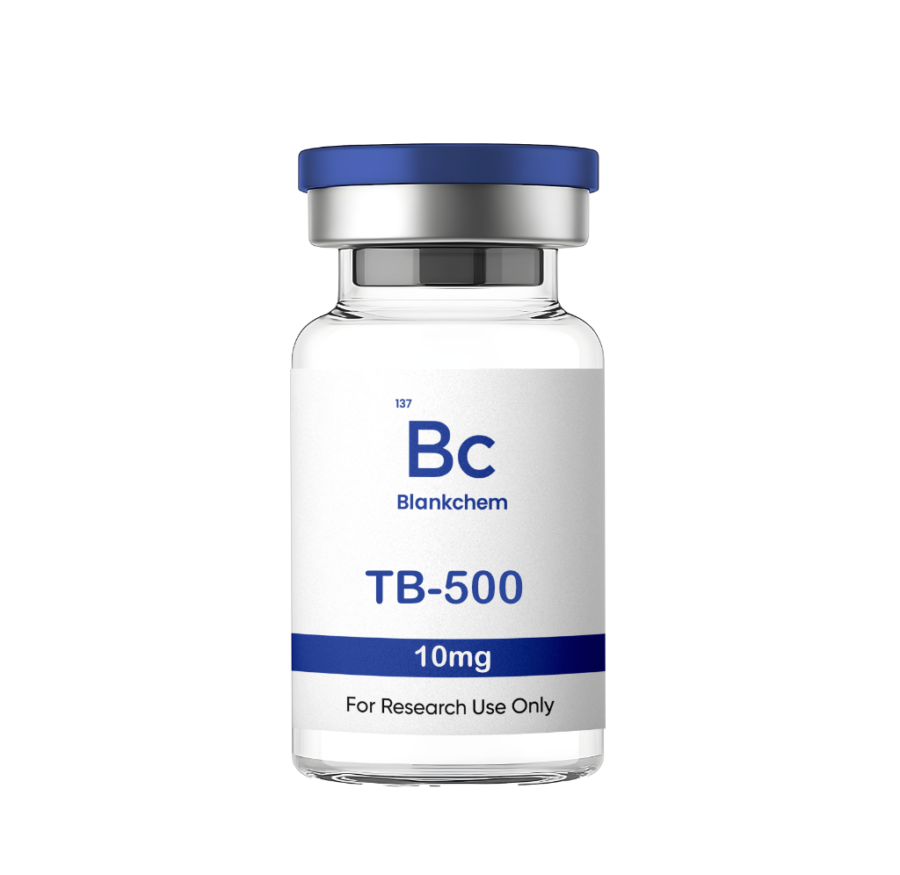
TB-500
Synthetic Thymosin Beta-4 fragment
This lyophilized peptide must be reconstituted with RECON-S before use in research. Most customers forget to add it — don't get stuck waiting for a second order.
Add Reconstitution SolutionTB-500 — 10mg
TB-500 is a synthetic analog of the 17 amino acid active region of Thymosin Beta-4, a naturally occurring protein encoded by the TMSB4X gene and found in high concentrations throughout virtually every cell in the human and animal body. Thymosin Beta-4 is one of the most abundant and evolutionarily conserved intracellular peptides identified in mammalian biology, with published research documenting its critical role in actin dynamics, cellular migration, and vascular development. TB-500 isolates and replicates the biologically active fragment of this protein — the actin-binding domain — making it a precise and highly studied research tool for investigating the molecular mechanisms underlying tissue modeling, angiogenesis, and cellular repair pathways in controlled laboratory settings.
Molecular Formula: C₂₁₂H₃₅₀N₅₆O₇₈S | Molecular Weight: ≈4,961 Da | Purity: ≥99% HPLC Verified
Each vial contains 10mg of lyophilized TB-500 with pharmaceutical-grade mannitol as a lyoprotectant. Every lot is analyzed by HPLC with mass spectrometry data included. Full COA available via our batch lookup tool.
For laboratory research purposes only. Not for human consumption. Research use only.
Once prepared for laboratory use, refrigerated storage is standard protocol. Research and stability studies indicate that prepared peptide solutions of this class typically maintain peak integrity for approximately 28 to 40 days under refrigerated conditions. Beyond this window researchers should account for potential degradation when designing experimental protocols.
For laboratory research purposes only. Not for human consumption. Research use only.
Lyophilized (unprepared) vials: In a cool, dry environment away from direct light and heat, lyophilized vials maintain compound integrity for approximately six months to one year. For extended preservation, deep freezer storage under stable conditions without repeated temperature cycling is appropriate. Published stability data for lyophilized peptides of this class suggests integrity can be maintained for several years under optimal frozen storage conditions — researchers should consult current literature for compound-specific stability data. Avoid repeated temperature cycling as it accelerates degradation regardless of storage temperature.
TB-500 arrives as a white to off-white lyophilized powder in a sterile sealed vial. Pharmaceutical-grade mannitol is included as a lyoprotectant, giving the powder visible bulk at the bottom of the vial. This is expected and normal.
Every batch undergoes independent HPLC analysis with mass spectrometry data included prior to shipping. Purity is verified at ≥99%. Full COA data is available via our batch lookup tool using your batch number.
TB-500 and BPC-157 are frequently studied together due to their overlapping research profiles, but they operate through distinct mechanisms. TB-500’s primary documented mechanism centers on actin sequestration and endothelial cell migration — systemic cellular activity mediated through the cytoskeleton. BPC-157’s research profile focuses more heavily on localized signaling through the nitric oxide system, VEGF pathway modulation, and fibroblast activity at specific tissue sites. Their mechanistic non-overlap is the scientific rationale behind co-administration in published animal research combining the two compounds.
Published research has examined TB-500’s effects on inflammatory markers in animal models, with studies investigating its influence on NF-κB signaling — a master regulator of inflammatory gene expression — and its effects on macrophage activity and cytokine profiles in tissue injury models. Research has also examined its interaction with the anti-inflammatory protein Tβ4-sulfoxide, a naturally occurring oxidized form of Thymosin Beta-4 produced during inflammatory responses. These findings have positioned TB-500 as a compound of interest in research examining the intersection of cellular repair and inflammatory pathway regulation.
Angiogenesis is the process by which new blood vessels form from pre-existing vasculature — a fundamental biological process involved in tissue repair, growth, and remodeling. TB-500 research has extensively examined its pro-angiogenic properties, specifically its ability to promote endothelial cell migration and blood vessel formation in laboratory models. Studies have documented TB-500’s interaction with the VEGF pathway and its capacity to upregulate endothelial cell motility through actin-mediated mechanisms. This pro-angiogenic activity has made TB-500 one of the most studied peptides in vascular biology research.
Preclinical studies in rodent and large animal models have examined TB-500 across a broad range of research contexts. Cardiac research has investigated its effects following induced myocardial infarction in animal models, with studies documenting activation of cardiac progenitor cells and endothelial migration markers. Skeletal muscle research has examined its role in satellite cell activation and muscle fiber repair models. Neurological research has investigated TB-500 in stroke and traumatic brain injury models, with studies documenting its effects on neural progenitor cell migration and vascular remodeling in affected tissue regions. Corneal and ocular research has examined its role in epithelial cell migration and wound closure in eye tissue models.
Actin is one of the most abundant proteins in eukaryotic cells and exists in two forms — globular actin (G-actin) and filamentous actin (F-actin). The dynamic interconversion between these two forms, known as actin polymerization, is fundamental to virtually every process involving cell movement, shape change, and division. TB-500’s primary documented mechanism involves its ability to sequester G-actin — binding to it and preventing polymerization into F-actin filaments. This sequestration promotes cell motility by increasing the pool of available G-actin monomers, facilitating the rapid cytoskeletal reorganization required for cellular migration. This mechanism is central to TB-500’s research applications across tissue modeling, wound healing biology, and vascular research.
TB-500 has a molecular formula of C₂₁₂H₃₅₀N₅₆O₇₈S and a molecular weight of approximately 4,961 Daltons. It corresponds to amino acid positions 17-23 of the full Thymosin Beta-4 sequence, specifically the tetrapeptide region Ac-LKKTETQ that has been identified in published research as the primary actin-binding and cell migration-promoting domain of the parent protein.
TB-500 is a synthetic peptide corresponding to the 17 amino acid active region of Thymosin Beta-4, a protein naturally produced throughout the body and found in exceptionally high concentrations in blood platelets, wound fluid, and most mammalian cells. Thymosin Beta-4 is encoded by the TMSB4X gene and is recognized as one of the most abundant and highly conserved peptides in mammalian biology. TB-500 was developed to isolate and study the specific actin-binding domain of Thymosin Beta-4 — the region responsible for the majority of its documented biological activity — allowing researchers to investigate its mechanisms with greater precision than studies using the full-length protein.