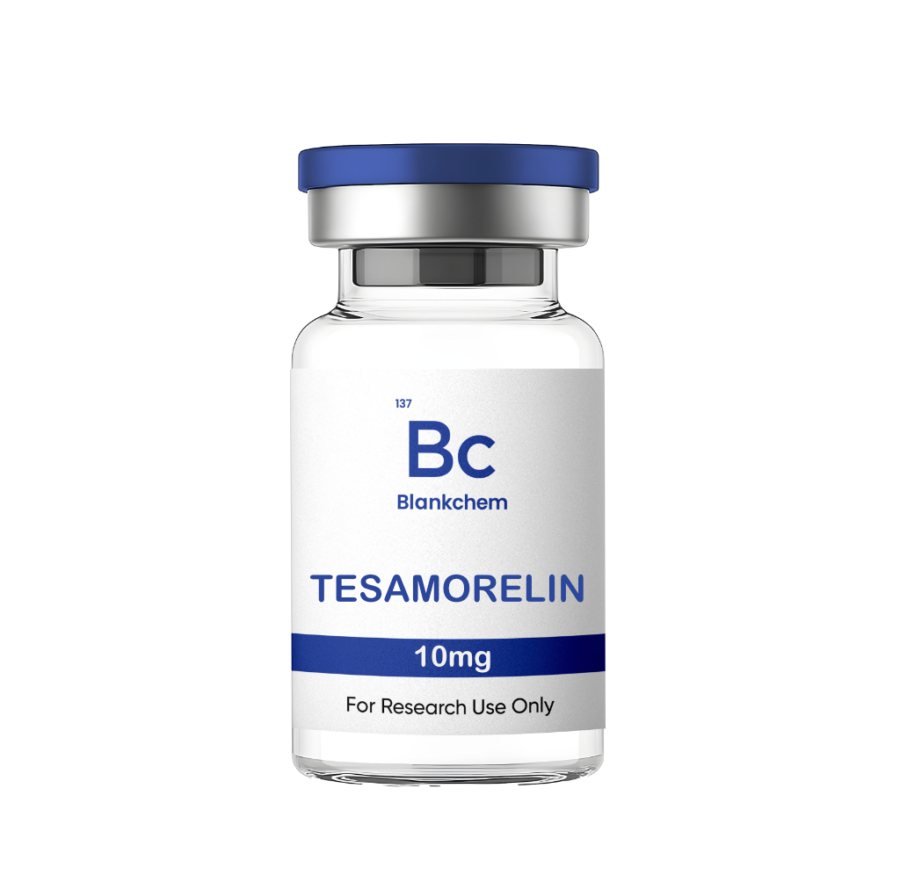
Tesamorelin
synthetic 44 amino acid growth hormone releasing hormone analog
This lyophilized peptide must be reconstituted with Acetic Acid before use in research. Most customers forget to add it — don't get stuck waiting for a second order.
Add Acetic AcidTesamorelin is a synthetic 44 amino acid analog of Growth Hormone-Releasing Hormone (GHRH) — the endogenous hypothalamic peptide responsible for stimulating pituitary growth hormone secretion. Unlike exogenous GH compounds, Tesamorelin acts upstream at pituitary somatotroph cells, engaging the natural GH/IGF-1 axis rather than bypassing it. This mechanism has made it one of the most studied GHRH analogs in modern endocrine research.
Tesamorelin is a synthetic analog of Growth Hormone-Releasing Hormone (GHRH), a 44 amino acid peptide produced naturally in the hypothalamus. GHRH is the primary upstream signal responsible for stimulating pituitary somatotroph cells to produce and secrete endogenous growth hormone. Tesamorelin was engineered as a stabilized analog of native GHRH with a trans-3-hexenoic acid group added to its N-terminus, significantly improving its resistance to enzymatic degradation and extending its functional activity compared to native GHRH. This structural modification is what makes it a practical and widely used compound in endocrine research settings.
Synthetic growth hormone directly introduces exogenous GH into a biological system, bypassing the hypothalamic-pituitary axis entirely. Tesamorelin operates differently — it acts on GHRH receptors located on pituitary somatotroph cells, stimulating the pituitary gland to produce and release its own endogenous growth hormone through the natural GH/IGF-1 axis. This distinction makes Tesamorelin a uniquely valuable research tool for studying hypothalamic-pituitary signaling dynamics, as it preserves the natural pulsatile pattern of GH secretion rather than introducing a continuous exogenous supply.
Preclinical studies in rodent models have examined Tesamorelin’s effects on growth hormone secretion, IGF-1 levels, lipid metabolism, and adipose tissue distribution. Animal model research has documented statistically significant increases in endogenous GH and IGF-1 levels following Tesamorelin administration, with researchers noting downstream effects on lipolytic activity — particularly in visceral adipose tissue. Studies have also investigated its effects on protein synthesis regulation, lean body mass composition, and cellular regeneration markers in animal subjects. Its influence on the GH/IGF-1 axis has made it a reference compound in endocrine signaling research.
The GH/IGF-1 axis is the hormonal signaling cascade through which growth hormone exerts its downstream metabolic and anabolic effects. Growth hormone secreted by the pituitary stimulates the liver to produce Insulin-like Growth Factor 1 (IGF-1), which in turn mediates many of GH’s effects on cellular growth, protein synthesis, lipid metabolism, and glucose regulation. Because Tesamorelin stimulates endogenous GH production through this axis rather than bypassing it, it has become a key research tool for studying the full signaling cascade from hypothalamic input through to downstream IGF-1 mediated cellular effects.
Tesamorelin binds to the GHRH receptor (GHRHR), a G protein-coupled receptor expressed predominantly on pituitary somatotroph cells. Activation of GHRHR triggers intracellular cAMP signaling cascades that stimulate growth hormone synthesis and secretion. Research has also identified GHRHR expression in peripheral tissues including the heart, kidney, and immune cells, making Tesamorelin a compound of interest beyond strictly endocrine research applications.
A significant body of research has examined Tesamorelin’s effects on lipid metabolism, particularly its influence on visceral adipose tissue. Studies in both animal models and human clinical research settings have documented reductions in visceral fat accumulation in subjects receiving Tesamorelin, with researchers attributing this to GH-mediated upregulation of lipolytic enzyme activity. Research has also examined its effects on triglyceride levels and lipid profiles in metabolic research models, making it one of the more extensively studied peptides in the context of endocrine-driven lipid regulation.
Tesamorelin is soluble in both sterile bacteriostatic water and acetic acid solution. Bacteriostatic water is the most commonly cited solvent in published research protocols for this compound. Researchers should consult compound-specific solubility data and published literature to confirm the appropriate solvent for their specific research application.
Every batch is independently tested for purity and identity prior to shipping. Full COA data including purity percentage and testing methodology is available via our batch lookup tool using your batch number.
Tesamorelin arrives as a white to off-white lyophilized powder in a sterile sealed vial. Pharmaceutical-grade mannitol is included as a lyoprotectant, giving the powder visible bulk at the bottom of the vial. This is expected and normal.
In a cool, dry environment away from direct light and heat, lyophilized vials maintain compound integrity for approximately six months to one year. For extended preservation, deep freezer storage under stable conditions without repeated temperature cycling is appropriate. Published stability data for lyophilized peptides of this class suggests integrity can be maintained for several years under optimal frozen storage conditions — researchers should consult current literature for compound-specific stability data. Avoid repeated temperature cycling as it accelerates degradation regardless of storage temperature.
Once prepared for laboratory use, refrigerated storage is standard protocol. Research and stability studies indicate that prepared peptide solutions of this class typically maintain peak integrity for approximately 28 to 40 days under refrigerated conditions. Beyond this window researchers should account for potential degradation when designing experimental protocols.
For laboratory research purposes only. Not for human consumption. Research use only.