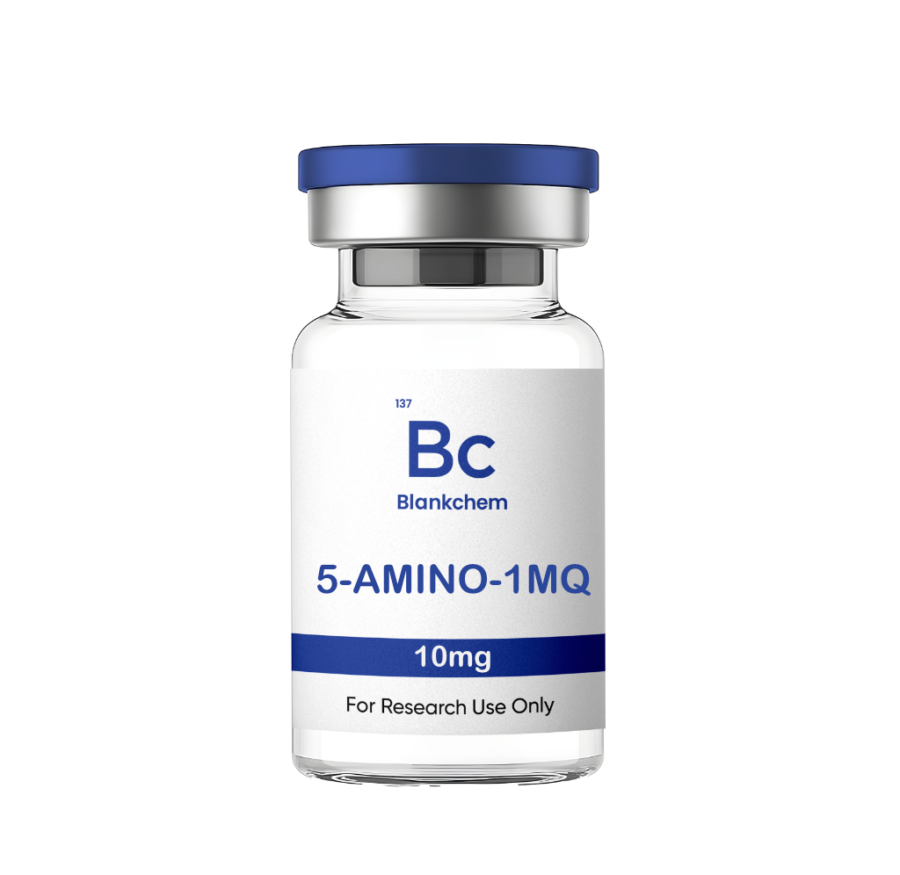
5-AMINO-1MQ
Selective NNMT Inhibitor
This lyophilized peptide must be reconstituted with RECON-S before use in research. Most customers forget to add it — don't get stuck waiting for a second order.
Add Reconstitution Solution5-Amino-1MQ
5-Amino-1MQ (5-Amino-1-methylquinolinium) is a small molecule selective inhibitor of Nicotinamide N-methyltransferase (NNMT) — an enzyme that plays a central role in cellular energy metabolism, fat storage, and NAD+ availability. Unlike peptide-based research compounds, 5-Amino-1MQ is a membrane-permeable small molecule, allowing it to enter cells directly and inhibit NNMT activity at the intracellular level. Its discovery and subsequent research have positioned it as one of the most compelling compounds in modern metabolic research, with published studies examining its effects on adipocyte metabolism, NAD+ biosynthesis, and the SIRT1 longevity pathway in animal models. As interest in NAD+ biology and metabolic regulation has expanded dramatically in research communities, 5-Amino-1MQ has emerged as a precise and selective tool for studying NNMT’s role as a master regulator of cellular metabolism.
Each vial contains lyophilized 5-Amino-1MQ with pharmaceutical-grade mannitol as a lyoprotectant. Independently tested for purity and identity. Full COA available via our batch lookup tool.
For laboratory research purposes only. Not for human consumption. Research use only.
5-Amino-1MQ (5-Amino-1-methylquinolinium) is a small molecule selective inhibitor of Nicotinamide N-methyltransferase (NNMT), an enzyme expressed predominantly in adipose tissue and the liver that catalyzes the methylation of nicotinamide — a form of vitamin B3 — using S-adenosylmethionine (SAM) as a methyl donor. By inhibiting NNMT, 5-Amino-1MQ prevents the consumption of nicotinamide through this methylation pathway, effectively redirecting it toward NAD+ biosynthesis. This makes 5-Amino-1MQ a uniquely positioned research tool at the intersection of epigenetic regulation, NAD+ biology, and metabolic research.
Nicotinamide N-methyltransferase (NNMT) is a cytosolic enzyme that transfers a methyl group from S-adenosylmethionine (SAM) to nicotinamide, producing 1-methylnicotinamide (MNA) and S-adenosylhomocysteine (SAH). Research has established NNMT as a significant regulator of cellular metabolism for two key reasons. First, its consumption of SAM — the primary methyl donor for DNA and histone methylation — links NNMT activity directly to epigenetic regulation and gene expression. Second, its consumption of nicotinamide reduces the availability of precursors for NAD+ biosynthesis, directly impacting cellular energy metabolism. Published research has documented significantly elevated NNMT expression in obese adipose tissue, making it a compound of substantial interest in metabolic disease research models.
Preclinical studies in rodent models have documented compelling effects of 5-Amino-1MQ on metabolic markers. Published research has documented significant reductions in adipocyte size and fat mass in animal subjects receiving 5-Amino-1MQ, with researchers attributing these effects to NNMT inhibition-driven increases in NAD+ levels and subsequent activation of the SIRT1 deacetylase pathway. Studies have also documented improvements in insulin sensitivity and glucose metabolism markers, increases in resting metabolic rate, and favorable changes in lipid profiles in treated animal subjects. Notably, these metabolic effects were observed without corresponding reductions in food intake in several published studies, suggesting a direct effect on metabolic rate rather than appetite-mediated mechanisms.
NAD+ (Nicotinamide Adenine Dinucleotide) is a coenzyme found in every living cell and is essential for cellular energy metabolism, DNA repair, and the activity of sirtuin deacetylases — a family of enzymes with extensively documented roles in metabolic regulation, stress response, and aging biology. NAD+ levels decline with age and in states of metabolic dysfunction, and restoring NAD+ levels has become a major focus of longevity and metabolic research. By inhibiting NNMT and preventing the diversion of nicotinamide away from NAD+ biosynthesis, 5-Amino-1MQ effectively increases intracellular NAD+ availability. This mechanism distinguishes it from direct NAD+ precursor supplementation strategies and makes it a precise research tool for studying NNMT’s specific contribution to cellular NAD+ pools.
SIRT1 (Sirtuin 1) is a NAD+-dependent deacetylase enzyme that regulates a broad network of metabolic and stress response genes. Its activity is directly dependent on intracellular NAD+ availability — when NAD+ levels are high, SIRT1 activity increases, triggering downstream effects including enhanced mitochondrial biogenesis, increased fatty acid oxidation, improved insulin sensitivity, and activation of the FOXO family of transcription factors involved in cellular stress resistance. Because 5-Amino-1MQ increases intracellular NAD+ through NNMT inhibition, research has examined whether this NAD+ increase is sufficient to activate SIRT1-mediated metabolic benefits in animal models — with published studies documenting SIRT1 pathway activation in adipose tissue following 5-Amino-1MQ treatment in rodent research.
NNMT’s consumption of SAM — the universal methyl donor — links its inhibition directly to epigenetic regulation. SAM is required for the methylation of DNA and histone proteins, processes that regulate gene expression without altering the underlying DNA sequence. By inhibiting NNMT and preserving SAM availability, 5-Amino-1MQ has been studied for its effects on the cellular methylation landscape — specifically its influence on histone methylation patterns in adipose tissue. Published research has documented changes in H3K4 trimethylation — a histone mark associated with active gene transcription — in adipocytes following NNMT inhibition, positioning 5-Amino-1MQ as a research tool at the frontier of metabolic epigenetics.
NMN (Nicotinamide Mononucleotide) and NR (Nicotinamide Riboside) are NAD+ precursors that increase intracellular NAD+ by providing additional substrate for the NAD+ biosynthesis pathway. 5-Amino-1MQ operates through an entirely different mechanism — rather than adding more precursor to the pathway, it inhibits the enzyme that diverts existing nicotinamide away from NAD+ synthesis. This mechanistic distinction makes 5-Amino-1MQ a complementary and independent research tool from NMN and NR, and allows researchers to study NNMT’s specific contribution to cellular NAD+ regulation independently of precursor availability.
Every batch is independently tested for purity and identity prior to shipping. Full COA data including purity percentage and testing methodology is available via our batch lookup tool using your batch number.
5-Amino-1MQ arrives as a white to off-white lyophilized powder in a sterile sealed vial. Pharmaceutical-grade mannitol is included as a lyoprotectant, giving the powder visible bulk at the bottom of the vial. This is expected and normal.
Lyophilized (unprepared) vials:In a cool, dry environment away from direct light and heat, lyophilized vials maintain compound integrity for approximately six months to one year. For extended preservation, deep freezer storage under stable conditions without repeated temperature cycling is appropriate. Published stability data for lyophilized peptides of this class suggests integrity can be maintained for several years under optimal frozen storage conditions — researchers should consult current literature for compound-specific stability data. Avoid repeated temperature cycling as it accelerates degradation regardless of storage temperature.
Once prepared for laboratory use, refrigerated storage is standard protocol. Research and stability studies indicate that prepared peptide solutions of this class typically maintain peak integrity for approximately 28 to 40 days under refrigerated conditions. Beyond this window researchers should account for potential degradation when designing experimental protocols.
For laboratory research purposes only. Not for human consumption. Research use only.